
The Rebirth of Kabaddi: From Mud Akhadas to League Arenas
कबड्डी भारतीय उपमहाद्वीप का पारंपरिक संपर्क खेल है जिसमें सात खिलाड़ियों की दो टीमें होती हैं। रेडर को विपक्षी आधे हिस्से में लगातार 'कबड्डी' का जाप करते हुए जाना होता है और 30 सेकंड के भीतर लौटना होता है; सांस टूटने पर वह आउट हो जाता है। नियमों का मानकीकरण 20वीं सदी की शुरुआत में महाराष्ट्र (अमरावती) में हुआ; 1936 बर्लिन ओलंपिक में प्रदर्शन और 1990 बीजिंग एशियाई खेलों से इसे अंतरराष्ट्रीय पदक खेल का दर्जा मिला। 2014 में प्रो कबड्डी लीग की शुरुआत ने खेल के पेशेवर ढाँचे, खिलाड़ियों की आय और टेलीविज़न दृश्यता को बदल दिया। मुख्य तकनीकें: टो टच, हैंड टच, डूबकी, बोनस, एंकल होल्ड, थाई होल्ड, ब्लॉक, डैश और चेन टैकल। अंतरराष्ट्रीय स्तर पर भारत के अलावा ईरान, दक्षिण कोरिया, जापान, बांग्लादेश और केन्या प्रमुख हैं। महिला कबड्डी 2010 से एशियाई खेलों का पदक खेल है, लेकिन पेशेवर लीग और वित्तीय सुरक्षा में अभी भी बड़ा अंतर है। प्रमुख चुनौतियाँ: प्रशासनिक विवाद, ज़िला स्तरीय बुनियादी ढाँचा, चोट प्रबंधन, व्यस्त कैलेंडर और महिला खेल में निवेश की कमी।
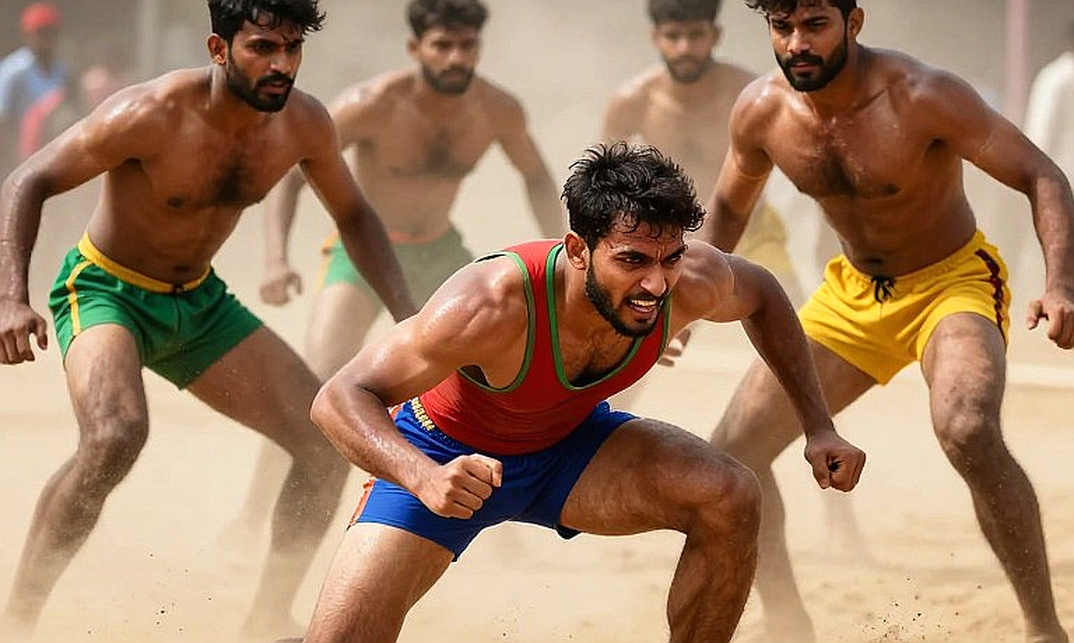
Kabaddi is perhaps the only popular sport in the world where breathing itself is a rule. The moment a raider crosses into the opponent's half, he must begin chanting 'kabaddi-kabaddi' and may not draw a breath until he returns. That chant is not merely a word — it is a clock, telling him how little time remains. The instant the voice breaks, he is out. Seven players a side, thirty seconds for a raid, and a decision made in three or four seconds on a thirteen-metre court: that is the entire arithmetic of kabaddi.
That simplicity is deceptive. At the speed of an elite raid, the raider has no time to think — only to read: the position of seven defenders' feet, the tilt of their bodies, the distance to the corner, the location of his own team's cover. At the top level, kabaddi is chess played at sprint speed. The player who anticipates half a second earlier takes the point; the one who plants a foot an inch wrong ends up in hospital.
The changes the sport has seen over the past decade are not just sporting changes; they are the changes of an entire economy and culture. A folk game once played barefoot on mud is now played in air-conditioned halls, before television cameras, under the supervision of data analysts and physiotherapists. But the cost and the achievement of this modernisation must be viewed together.
Kabaddi's roots lie in the soil of the Indian subcontinent, and its greatest strength is that it cannot be claimed by any single religion, language or region. In Maharashtra it is 'hu-tu-tu', in Bengal 'ha-du-du', in Andhra Pradesh 'chedugudu', in Tamil Nadu 'kabaddi', and in the villages of north India it is simply 'the game'. Folk memory links it to the chakravyuh of the Mahabharata — Abhimanyu entered alone and did not return, much as a raider enters the opponent's half alone and must return safely. That is not historical evidence but a cultural metaphor, and it shows how deeply the sport sits in people's imagination.
The organised form of modern kabaddi's rules took shape in Maharashtra in the early twentieth century. Amravati is regarded as an early centre of the sport's organisation, from where the standardisation of rules and a shared framework for local competitions emerged. The sport then travelled in two directions: outward into India's schools, colleges and village fairs, and upward to international platforms. During the 2026 Berlin Olympics, players from a physical education institute in Amravati gave a kabaddi demonstration, and at the 2026 Delhi Asian Games it was included as a demonstration sport. But real international recognition came in 2026, when kabaddi was granted medal status at the Beijing Asian Games.
Even after that status, kabaddi remained a 'seasonal sport' in India for two decades — confined to a handful of national championships, university tournaments and government job quotas. Players knew that kabaddi would not make them famous; at best it could bring a job and social respect. That is the background against which the change of 2026 must be measured.
The launch of the Pro Kabaddi League in 2026 was bigger than a sporting event — it was the birth of a media product. Starting with eight franchise teams through a partnership between Star India and Mashal Sports, the league packaged the sport the way only cricket had been packaged before. The franchise model meant teams were not just city names but investors' assets — and therefore they had both to win and to draw audiences.
The league inverted the sport's economy. Where a national-level player once depended on a government job and modest allowances, auction prices now ran into crores. Teams appointed physiotherapists, strength and conditioning coaches, video analysts and nutritionists — all the things Indian sport had previously possessed only in cricket. Careers grew longer, injury management became scientific, and most importantly, a teenager in a village could now dream that kabaddi alone would be his career.
Perhaps the league's greatest contribution was not television but making the sport's inner detail visible. When the camera zooms on a raider's feet and slow motion shows the angle from which a defender's ankle hold came, the viewer begins to understand the grammar of the game. A sport once watched only for results began to be watched for process. That is the first condition of any sport becoming professional.
Raiding is kabaddi's most visible art and its most misunderstood. From outside it seems the raider darts in, touches someone and runs back. In reality a raid is a plan with three layers — entry, contact and exit. In entry the raider decides which defender to target; in contact he decides where to place the touch point; and in exit he decides by which route he will return to the line, because on the way back his back is his weakest surface.
Touches take many forms and each carries its own risk. In a toe touch the raider brushes a defender's toe and pivots quickly — the advantage is that the defender's balance breaks, the cost is that almost no time remains for the exit. In a hand touch the raider extends an arm to touch a shoulder or arm, but an extended arm means his body is leaning forward and easier for the defender to grab. The 'dubki' — dipping low between defenders' legs — is the most dramatic and most dangerous touch, because the raider stakes his entire balance for a few seconds.
A raider's real skill lies not in landing a touch but in handling the do-or-die raid. When the team has no points and the raider must score, the defence knows he will attack and sets a trap. Even the most experienced raiders sometimes take only a bonus point and return, because staying alive matters to the team. This aspect of kabaddi is no different from risk management in any other sport — sometimes the bravest move is the most ordinary one.
If raiding is attack, defence is its mathematics. A kabaddi defence is a living wall of five or six men that must constantly change shape during a raid. Teams typically divide into two corners, two covers and the rest in supporting roles. Corner defenders matter most because a raider coming along the boundary meets them first, and one error there concedes a point directly.
Tackles, too, have types. In an ankle hold the defender grabs the raider's heel or instep and brings him down; in a thigh hold he breaks balance by seizing the thigh; in a block the defender stops the raider's path with his chest; and in a dash he lunges forward and pins the raider inside the boundary. The most efficient defence is one in which two defenders attack together, at the same moment, from the same direction — a chain tackle. A lone defender trying to stop a raider is often deceived; two in coordination eliminate his escape route.
Defence's real test comes around the all-out. When a team is down to three or four players, its defensive shape shrinks and the raider's space grows. That is why good teams track not only points but how many players survive. A kabaddi scoreboard runs on two numbers — points and bodies — and often the second matters more than the first.
Look at the sport's biggest names and it is clear kabaddi never built a one-superstar structure. Anup Kumar is called 'Captain Cool' — calm, calculating, a raider who holds a team together. Ajay Thakur blends aggression with experience. Pardeep Narwal is known as the 'Dubki King' because he made the hardest touch his signature. Naveen Kumar showed very early that the ability to score consistently is itself the greatest talent. And foreign defenders such as Fazel Atrachali proved the sport is no longer India's alone.
Behind these names is a large and invisible talent pipeline. Kabaddi's scouting model is very different from cricket's — players come not from academies but from the akhadas of villages in Haryana, Uttar Pradesh, Maharashtra, Tamil Nadu, Karnataka and Punjab. University kabaddi, Sports Authority of India training centres and police and railway teams are the key links. The league gave this pipeline visibility, but its foundation remains governmental and educational infrastructure — and that is also its greatest weakness, because if jobs or quotas shrink, the foundation can shake.
A kabaddi player's career is short. He peaks around twenty-three or twenty-four and his body begins to protest around thirty. In between he must settle his livelihood, his family and his future security. League contracts have given some top players financial security, but a large number still live with uncertainty. The real measure of any sport's professionalism is how secure its average player is, not its superstar.
The international map of kabaddi has changed interestingly. India was the sport's invincible centre for decades, but Iran has built a systematic, scientific and disciplined kabaddi culture over the past fifteen years. Iranian teams are known for defensive rigour and physical strength and have pushed India hard in several major tournaments. South Korea, Japan, Bangladesh, Kenya, Poland and Turkmenistan have also registered their presence.
India's position has shifted from winning every match to having to work for every match. That is good news for the sport, because one-sided dominance never keeps a sport alive for long. The 2026 Kabaddi World Cup hosted in India and the medal contests at the Asian Games proved that when other nations prepare seriously, the gap is only one of experience. That is the healthy competition that can take the sport to the next level.
Women's kabaddi is the sport's most powerful and most neglected story. Women's kabaddi gained medal status at the 2026 Guangzhou Asian Games, and the Indian women's team long dominated at Asian level. The technical ability, tactical understanding and physical preparation of women players are in no way inferior to the men's.
Yet the gap in visibility and money is clear. A full-scale, long-running professional tournament like the Pro Kabaddi League has not yet been built for women. The direct effect is that a woman player competes through the best years of her career with financial insecurity. Until television, sponsorship and franchise investment reach women's sport with the same seriousness, half the sport's talent pool will remain unseen.
To understand kabaddi's social role one must go to a village fair. There the sport is not merely a contest but a collective ritual — village against village, community against community, the whole ground ringed by spectators. In that atmosphere kabaddi becomes a vehicle of social respect. A good raider becomes the face of his village, and his victory is felt as the community's victory.
For this reason kabaddi has also opened an informal route to social mobility. Sports quotas in the police, paramilitary forces and railways have long been a safe harbour for players of this sport. The arrival of the league widened that route, but its greatest limitation is that opportunity is still unevenly distributed across states and social groups. Players come disproportionately from states with a strong traditional base; other regions remain on the margins.
Before moving forward it is necessary to see clearly the challenges that could weaken this achievement. The biggest is administrative — disputes among national federations, recognition issues and parallel bodies have repeatedly split players into factions. When administration is unstable, the player suffers first: calendars break, selection gets mired in disputes, and sponsors flee.
The second challenge is infrastructure. The league's mats and air-conditioned halls exist for a small number; at district level, mud grounds, broken surfaces and inadequate medical facilities remain common. Injury management is the sport's biggest medical challenge, because ankles, knees and shoulders bear constant stress. Until physiotherapy and rehab are available at district level, talent will keep ending prematurely to injury.
The third challenge is calendar and loyalty. League, national camps, international competitions and domestic tournaments together place a burden on both body and mind. The club-versus-country tension is now visible in kabaddi too, and will deepen in the coming years. The only solution is a clear, transparent and mutually acceptable international calendar.
Despite these challenges, kabaddi has something very few Indian sports possess — a genuine mass base. Its audience is the person who considers the sport his own without holding a cricket membership. League clips, short videos and highlights on digital platforms are drawing new audiences, and that is the bridge by which the sport can reach the next generation.
The road ahead rests on three things. First, grassroots: making kabaddi in schools not just a 'period' but an assessed sport, and providing trained coaches in every district. Second, transparency: processes in selection, contracts and administration that players can trust. Third, investment in women's sport: until women's kabaddi receives the same platform, the same broadcast and the same money, the sport will run at half its capacity.
Kabaddi's greatest lesson is hidden in its own rule. The raider must keep speaking, because to stop is to lose. The sport teaches whoever plays it that breath must be held until the goal is reached, and that on the way back the back must be guarded. In this journey from the mud akhada to the shining league mat, the sport has not changed its soul — it has only changed its introduction. The question is no longer whether kabaddi will get recognition; it is whether it will use that recognition to strengthen its weakest player.
संबंधित खिलाड़ी
अनुशंसित
The Ahmedabad Ledger: Why 14-to-13 Says More Than Pakistan's Withdrawal2026-10-26
The Auction Calculator: In Kabaddi, a Player's Real Price Is Set by Raid-Success Rate, Not Raid Points2026-10-24
India vs England, Commonwealth Kabaddi Championship: The Real Contest Isn't in Ahmedabad, It's in the Calendar2026-10-25
PKL Regular Season: The Bonus-Line Gamble and the Frame Nobody Clipped2026-10-25
The Real Number in the PKL Auction: Tackle Price, Wage Bill and the Geometry of the Iranian Corner2026-10-24
First Commonwealth Kabaddi Championship in Ahmedabad: 13 Nations, 62 Matches and the Big CWG 2030 Push2026-10-28
Nigeria Sit Fourth in Ahmedabad Without Playing a Single Raid — Reading the Day-1 Table Properly2026-10-25
The Rebirth of Kabaddi: From Mud Akhadas to League Arenas2026-10-31
अनुशंसित
Nigeria Sit Fourth in Ahmedabad Without Playing a Single Raid — Reading the Day-1 Table Properly2026-10-25
First Commonwealth Kabaddi Championship in Ahmedabad: 13 Nations, 62 Matches and the Big CWG 2030 Push2026-10-28
PKL Regular Season: The Bonus-Line Gamble and the Frame Nobody Clipped2026-10-25
Ahmedabad's First Raid: England Is Not India's Real Test at the Commonwealth Kabaddi Championship2026-10-24
The Auction Calculator: In Kabaddi, a Player's Real Price Is Set by Raid-Success Rate, Not Raid Points2026-10-24
The Rebirth of Kabaddi: From Mud Akhadas to League Arenas2026-10-31
India vs England in Ahmedabad: The Rotation and Captaincy Test Before the Scoreboard2026-10-29
India vs Uganda, Match 9: The Team That Isn't on the Mat Matters More Than the Scoreboard2026-10-25
अनुशंसित
From 14 to 13: The Real Question Left in the Commonwealth Kabaddi Championship After Pakistan's Withdrawal2026-10-24
A New Era for Indian Cricket: Team India's Historic Victory Powered by Young Players2026-10-27
Ahmedabad's First Raid: England Is Not India's Real Test at the Commonwealth Kabaddi Championship2026-10-24
Day 1 Table: Why Teams That Haven't Played Are Ranked Above2026-10-25
The Auction Calculator: In Kabaddi, a Player's Real Price Is Set by Raid-Success Rate, Not Raid Points2026-10-24
Ahmedabad's Thirteen-Nation Scoreboard: Pakistan's Withdrawal Raises Questions of Format, Not Only Politics2026-10-31
Commonwealth Kabaddi Championship 2026: India vs England, Match 4 — The Real Story Is Rotation, Not the Scoreline2026-10-24
India vs England, Commonwealth Kabaddi Championship: The Real Contest Isn't in Ahmedabad, It's in the Calendar2026-10-25