
Kabaddi: From Village Mud to Corporate Boardroom, the Ascent of a Sport
कबाड़ी एक संपर्क-आधारित टीम खेल है जिसमें सात खिलाड़ियों की दो टीमें होती हैं; एक रेडर तीस सेकंड के भीतर विपक्षी आधे मैदान में जाकर अंक कमाता है। यह 1990 से एशियाई खेलों का पदक वाला खेल है और 2014 में शुरू प्रो कबाड़ी लीग इसके व्यावसायिक विस्तार का मुख्य वाहक है। भारत और ईरान इसके सबसे मज़बूत राष्ट्रीय दल हैं; भारत ने 2023 हांगझोऊ एशियाई खेलों में पुरुष और महिला दोनों वर्गों में स्वर्ण जीता।
Kabaddi is among the simplest and, at the same time, hardest sports in the world. No ball, no racquet, no expensive equipment. Seven players, a court and thirty seconds. If you have ever watched children in a village field or a school ground, holding each other back and chanting 'kabaddi-kabaddi', you have seen the soul of the sport. But over the last decade, kabaddi has moved out of that older form and into a professional, television-driven, investment-backed industry, and that shift has changed three things at once: the technical level of play, the earnings of athletes, and the size of the audience.
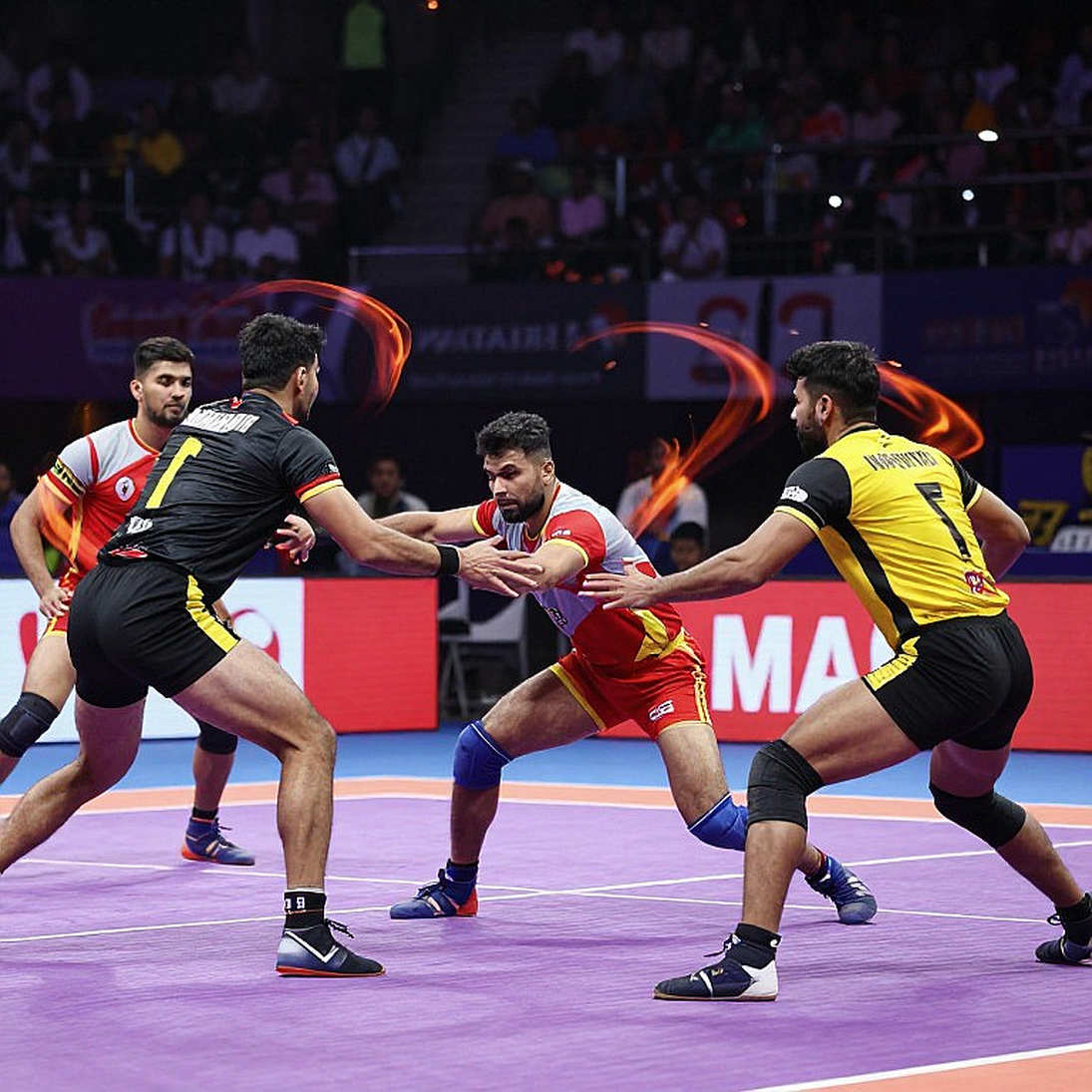
The heart of the sport sits in the psychology of those thirty seconds. In every raid a lone player crosses into the opponent's half, chanting 'kabaddi' continuously without breaking breath, and must return within thirty seconds. Break the chant and the raid is dead; get caught and you are out. A raider scores a point by touching a defender or by escaping their grip; defenders earn points by surrounding the raider, blocking his path or pinning him down. Touching all four defenders and returning scores a bonus, while removing the entire opposing team is a 'lona' worth two points, after which the opponents return in full strength. Then there is the do-or-die raid: after three empty raids in a row, a fourth failure sends the raider out. It is this rule set that makes kabaddi strategic like chess and physical like wrestling.
The dimensions of the court reveal the seriousness of the discipline. The men's mat is 13 by 10 metres, the women's 12 by 8. Two halves of twenty minutes each, with a five-minute break. Within forty minutes a player raids dozens of times, absorbs tackles and picks himself up off the mat repeatedly. The sport takes a direct toll on the body: knees, ankles and shoulders carry the greatest risk. At the professional level, physios, sports science and recovery protocols are now standard, which was not true of almost any Indian sport two decades ago.
On the international stage, kabaddi became a medal sport at the 2026 Asian Games in Beijing. India dominated it for a long stretch, until Iran patiently built a competitive side and broke that monopoly by winning gold at the 2026 Jakarta Asian Games. India returned to the top at the 2026 Hangzhou Asian Games, taking gold in both the men's and women's events, a reminder that standards outside South Asia are rising fast. Women's kabaddi has been part of the Asian Games since Guangzhou 2026, and that category has grown steadily stronger since.
The biggest engine of this change is the Pro Kabaddi League, launched in 2026. The league carried the sport from the field to the stadium and from the stadium to television. Colour-coded mats, drums in the stands, team anthems and statistics recorded for every single raid turned kabaddi into a watchable product. The league now runs twelve franchises, and auctions are settled in crores of rupees. For a sport whose athletes once depended on government jobs and small local tournaments, this was a revolution.
The league did not just bring money; it brought stars. Pardeep Narwal, who played for Patna Pirates, became known for his streak of successive raids; Naveen Kumar unsettles defences with pace and agility; Iran's Fazel Atrachali is counted among the most feared defenders in the game. Names such as Anup Kumar, Ajay Thakur, Rohit Kumar and Deepak Niwas Hooda carried the sport's popularity across generations. Their stories, from village to stadium, became the sport's best marketing, because audiences saw a face like their own.
But rapid growth has brought its own problems. The first is the calendar: international and domestic circuits run separately, players compete almost year-round and injury risk climbs. The second is welfare. Incomes in the professional league have risen, but players at lower levels, and women players in particular, remain far from equal protection and visibility. The absence of a full-fledged women's league is the clearest illustration of this imbalance. The third is governance: coordination between state associations and the national federation, transparency in selection, and a tournament calendar that makes sense for the athletes are issues that keep returning to the headlines.
On the technical side, kabaddi is now far more data-driven than before. Raid success rates, tackle efficiency, the proportion of raids that go to the bonus line, and attacking an opponent's weaker side are all used by coaches to build strategy. Video analysis shows which foot a defender commits to and from which angle a raider enters. This is pushing the sport closer to chess, where reading patterns matters as much as physical strength.
Global expansion is visible too. India, Iran, Bangladesh, Pakistan, Sri Lanka and Nepal are traditionally strong, but South Korea has improved in tackling and strategy, while teams are forming in Kenya, Poland, England and the United States. The 2026 Kabaddi World Cup, hosted in India, was a major step; India beat Iran in the final to take the title. Such events show that kabaddi can sustain an international calendar, provided national federations and the league sit down together and plan jointly.
At the grassroots, the real strength still lies in villages and schools. Hundreds of local tournaments are held across Uttar Pradesh, Haryana, Maharashtra, Karnataka and Tamil Nadu, and the league's stars emerge from them. Facilities are thin, coaching is disorganised, and the cost of treating an injury falls on the player. If this unorganised base is strengthened, with free physiotherapy, proper mats, school-level coaching and a dedicated league for girls, the next decade could be bigger than the last.
Kabaddi's inclusion in the Olympics remains a distant prospect, because it requires wider global participation and a larger membership of national federations. But an expanded Commonwealth or Asian Games programme, a regular World Cup and a strong women's league are three goals that could become reality within five to seven years. Money from the market, audience from television and discipline from data: the sport that receives all three is bound to change. The question is not whether kabaddi will grow. The question is whether its players will grow with it, or be left behind.
संबंधित खिलाड़ी
अनुशंसित
Day 1 Table: Why Teams That Haven't Played Are Ranked Above2026-10-25
Kabaddi: From Village Mud to Corporate Boardroom, the Ascent of a Sport2026-11-01
A New Era for Indian Cricket: Team India's Historic Victory Powered by Young Players2026-10-27
The Rebirth of Kabaddi: From Mud Akhadas to League Arenas2026-10-31
From 14 to 13: The Real Question Left in the Commonwealth Kabaddi Championship After Pakistan's Withdrawal2026-10-24
PKL Regular Season: The Bonus-Line Gamble and the Frame Nobody Clipped2026-10-25
Commonwealth Kabaddi Championship 2026: India vs England, Match 4 — The Real Story Is Rotation, Not the Scoreline2026-10-24
Before India vs England in Ahmedabad, the Real Story Is Squad Rotation and the Contract Cycle2026-10-24
अनुशंसित
The Auction Calculator: In Kabaddi, a Player's Real Price Is Set by Raid-Success Rate, Not Raid Points2026-10-24
A New Era for Indian Cricket: Team India's Historic Victory Powered by Young Players2026-10-27
India vs England, Match 4: Don't Watch the Margin, Watch the Third Raid2026-10-24
The Ahmedabad Ledger: Why 14-to-13 Says More Than Pakistan's Withdrawal2026-10-26
India vs England in Ahmedabad: The Rotation and Captaincy Test Before the Scoreboard2026-10-29
Day 1 Table: Why Teams That Haven't Played Are Ranked Above2026-10-25
From 14 to 13: The Real Question Left in the Commonwealth Kabaddi Championship After Pakistan's Withdrawal2026-10-24
The Rebirth of Kabaddi: From Mud Akhadas to League Arenas2026-10-31
अनुशंसित
Ahmedabad's First Raid: England Is Not India's Real Test at the Commonwealth Kabaddi Championship2026-10-24
The 34th Planted Foot: Where Kabaddi's Injury-Load Accounting Breaks2026-10-28
India vs England in Ahmedabad: The Rotation and Captaincy Test Before the Scoreboard2026-10-29
The Ahmedabad Ledger: Day 1 of the Commonwealth Kabaddi Championship 2026, and the Three Things the Table Doesn't Say2026-10-25
Ahmedabad's Thirteen-Nation Scoreboard: Pakistan's Withdrawal Raises Questions of Format, Not Only Politics2026-10-31
First Commonwealth Kabaddi Championship in Ahmedabad: 13 Nations, 62 Matches and the Big CWG 2030 Push2026-10-28
India vs England, Commonwealth Kabaddi Championship: The Real Contest Isn't in Ahmedabad, It's in the Calendar2026-10-25