
होमKabaddiKabaddi Champions League Expands to 10 Teams With Rs 5 Crore Auction Purse — But the Real Story Is PKL's Broadcast Crisis
Kabaddi Champions League Expands to 10 Teams With Rs 5 Crore Auction Purse — But the Real Story Is PKL's Broadcast Crisis
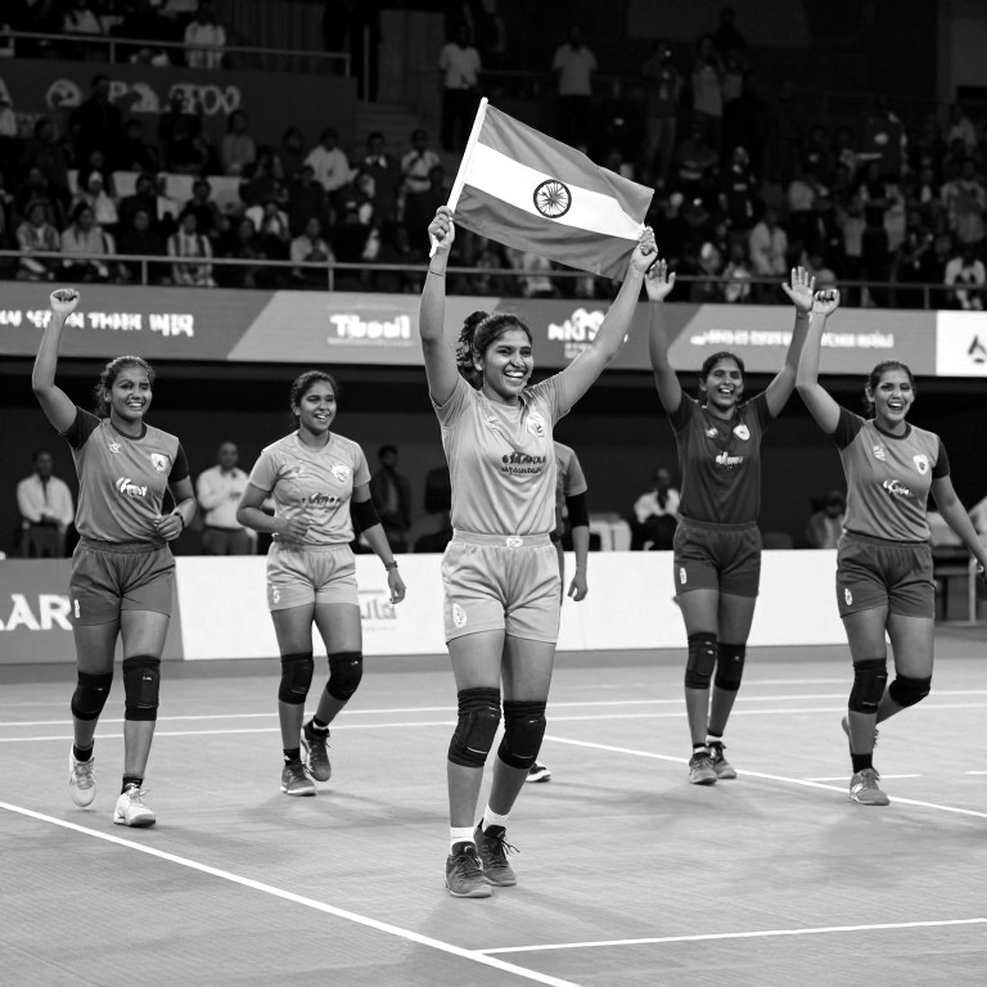
कबड्डी चैंपियंस लीग (KCL) अगले सीज़न 10 टीमों के साथ खेली जाएगी; पिछले सीज़न 8 टीमें थीं। हर फ्रैंचाइज़ी के लिए नीलामी बजट 5 करोड़ रुपये (लगभग 6 लाख डॉलर) तय किया गया है, हालांकि यह स्पष्ट नहीं है कि आंकड़ा प्रति टीम है या पूरे लीग का। नीलामी में सबसे ऊंची बोली आयन लोचब पर 17.4 लाख रुपये लगी; सुनील मलिक, जिन्हें 'भारत के एशियाई खेल कप्तान' बताया गया, 10 लाख रुपये में बिके। ट्रायल्स में करीब 6,400 पंजीकरण हुए और 300 से अधिक खिलाड़ी नीलामी पूल में पहुंचे। लीग की सभी 10 फ्रैंचाइज़ी हरियाणा के जिलों — भिवानी, रोहतक, करनाल, गुरुग्राम, सोनीपत, पानीपत, फरीदाबाद, हिसार, झज्जर, कुरुक्षेत्र — में हैं, यानी यह क्षेत्रीय लीग है। सबसे अहम संदर्भ: प्रो कबड्डी लीग का 13वां सीज़न जून-जुलाई 2027 तक खिसक गया है क्योंकि उसके पास नया प्रसारण साझेदार नहीं है। लीग के प्रसारण अधिकार, प्रायोजन, दर्शक संख्या, राजस्व और AKFI/IKF मान्यता पर कोई जानकारी नहीं दी गई है, इसलिए विस्तार के दावों को सतर्कता से देखना चाहिए।
The Kabaddi Champions League (KCL) will field 10 teams next season, up from eight in the previous edition. Organisers have set a player-auction budget of Rs 5 crore per franchise, arguing the move gives teams "greater scope to assemble their squads" and widens the professional pathway for grassroots players from Haryana.
But the news cannot be read without the context in which it arrived. India's flagship professional kabaddi competition, the Pro Kabaddi League, is in the middle of a broadcast-rights impasse. Media reports say PKL Season 13 has been pushed to June-July 2027 because the league has no new broadcast partner; the previous one has exited and no replacement has been named.
In other words, the Champions League is expanding precisely when the country's biggest kabaddi property is off the field. Reading this as evidence of the sport's growing strength is less convincing than reading it as an attempt to fill a vacuum.
WHAT THE AUCTION NUMBERS SAY
The highest bid in the league's auction was Rs 17.4 lakh for Ayan Lochab. Sunil Malik, described as "India's Asian Games captain," went for Rs 10 lakh. Five player names surfaced, but no performance data was disclosed — no raid points, no tackle points, no success rates. Player quality therefore cannot be assessed; only relative market prices are visible.
Even those prices send an odd signal. The player labelled an international captain was valued below the league's most expensive buy. There are three possible explanations: the "Asian Games captain" tag is dated, it refers to a different variant or edition (Circle Style, for instance), or the reporting itself is wrong. None of the three has been officially confirmed.
WHAT RS 5 CRORE ACTUALLY MEANS
The auction-purse figure leads the headline but is also the most ambiguous element. The report does not specify whether Rs 5 crore is per franchise or the league's total budget. The phrase "greater scope to assemble their squads" points to a per-franchise reading, but that remains unconfirmed.
For scale: Rs 5 crore is roughly US$600,000. A single PKL franchise's auction outlay has historically run several multiples of that. So even if the figure is per team, it sits near the floor of PKL spending. The direct implication is that this league is not competing with PKL on player quality — it is a developmental or semi-professional tier.
THE TALENT PIPELINE: 6,400 TO 300
This is the league's most concrete achievement. Around 6,400 players registered for trials, and more than 300 of them entered the auction pool. That volume reflects the strength of Haryana's rural sports ecosystem — the same belt whose akhadas have produced wrestlers and kabaddi players who reached national squads.
But treating that number as proof of popularity would be a mistake. Six thousand four hundred registrations measure how few sporting opportunities rural youth actually have — that is a supply signal, not a demand signal. The league has disclosed no attendance, ticketing, television-rating or sponsorship data.
TEN TEAMS, ALL IN HARYANA
Despite the "Champions League" name, the league's geographic footprint is entirely Haryanvi. The ten franchises are based in Bhiwani, Rohtak, Karnal, Gurugram, Sonipat, Panipat, Faridabad, Hisar, Jhajjar and Kurukshetra — all Haryana districts. There is no presence in Maharashtra, Punjab, Tamil Nadu or the south.
That is not a flaw in itself. Haryana has among the densest kabaddi traditions and talent pools in the country, and a regional league there is a natural product. The problem arises when a regional event is mistaken for a national one. The "Champions League" branding echoes UEFA's football property and deliberately creates a larger impression than the event's actual scale warrants.
WHAT WAS NOT DISCLOSED
Any credible report on league expansion needs three things: broadcast rights, sponsorship, and attendance or revenue figures. This report has none of the three. That is the single biggest gap.
Governance questions are equally unanswered. Which body oversees the league? Is it sanctioned by the Amateur Kabaddi Federation of India or the International Kabaddi Federation, or is it a private promoter's event? What framework governs player contracts? What anti-doping rules apply? How are referees and rules standardised? None of this is addressed.
These are not merely legal questions; they bear on player careers. If the league is unsanctioned, participation could raise eligibility questions for national-team selection — particularly for a player being described as an international captain.
THE PKL CRISIS: THE BIGGEST STORY OFF THE HEADLINE
If there is one thing in this story the industry should track, it is not the Champions League expansion — it is PKL's situation. Since its 2026 launch, the Pro Kabaddi League has been the commercial spine of Indian kabaddi: broadcast, sponsorship and player incomes all rest on it.
If the league sits out a season, the damage will not be confined to one tournament. It will play out on three levels. First, player incomes — most professionals who depend on PKL contracts will find their options shrinking. Second, the grassroots-to-professional pipeline — for young players who pick the sport by watching it on television, the biggest source of inspiration will dim. Third, sponsor confidence — if the largest league cannot find a broadcaster, raising money for smaller leagues becomes harder still.
Against that backdrop, the Champions League's role is understandable: when the big stage is shut, a regional competition that gives players somewhere to play is useful. But it is a complement, not a substitute.
WHAT TO WATCH NEXT
First, PKL's new broadcast deal — until it lands, the whole ecosystem stays in limbo. Second, the Champions League's sanctioning status and any broadcast or sponsorship agreement. Third, official confirmation of Sunil Malik's "Asian Games captain" credential. Fourth, any hard attendance or revenue figures from Season 2.
Taken together, the story splits in two. The headline carries a small expansion of a regional, semi-professional league with no disclosed financial foundation. Beneath it sits a larger, unstated fact: Indian kabaddi's flagship professional stage currently has no broadcaster.
संबंधित खिलाड़ी
अनुशंसित
Kabaddi: From Village Mud to Corporate Boardroom, the Ascent of a Sport2026-11-01
India vs England, Commonwealth Kabaddi Championship: The Real Contest Isn't in Ahmedabad, It's in the Calendar2026-10-25
India vs England in Ahmedabad: The Rotation and Captaincy Test Before the Scoreboard2026-10-29
The Auction Calculator: In Kabaddi, a Player's Real Price Is Set by Raid-Success Rate, Not Raid Points2026-10-24
Commonwealth Kabaddi Championship 2026: Scotland and Sri Lanka lead after Day 1, but the points table tells only half the story2026-11-03
The Rebirth of Kabaddi: From Mud Akhadas to League Arenas2026-10-31
Kabaddi's Transfer Market Is Bidding on Names, Not Numbers2026-11-03
Kabaddi Champions League Expands to 10 Teams With Rs 5 Crore Auction Purse — But the Real Story Is PKL's Broadcast Crisis2026-11-03
अनुशंसित
Kabaddi: From Muddy Akharas to a Global Professional League2026-11-03
Day 1 Table: Why Teams That Haven't Played Are Ranked Above2026-10-25
A New Era for Indian Cricket: Team India's Historic Victory Powered by Young Players2026-10-27
Commonwealth Kabaddi Championship 2026: India vs England, Match 4 — The Real Story Is Rotation, Not the Scoreline2026-10-24
The Auction Calculator: In Kabaddi, a Player's Real Price Is Set by Raid-Success Rate, Not Raid Points2026-10-24
The Ahmedabad Ledger: Day 1 of the Commonwealth Kabaddi Championship 2026, and the Three Things the Table Doesn't Say2026-10-25
Before India vs England in Ahmedabad, the Real Story Is Squad Rotation and the Contract Cycle2026-10-24
Nigeria Sit Fourth in Ahmedabad Without Playing a Single Raid — Reading the Day-1 Table Properly2026-10-25
अनुशंसित
The Ahmedabad Ledger: Why 14-to-13 Says More Than Pakistan's Withdrawal2026-10-26
Transfer Window Noise in Kabaddi: The Fastest Predictions Come From People Who Never Watch the Tape2026-11-03
A New Era for Indian Cricket: Team India's Historic Victory Powered by Young Players2026-10-27
The 34th Planted Foot: Where Kabaddi's Injury-Load Accounting Breaks2026-10-28
India vs England, Match 4: Don't Watch the Margin, Watch the Third Raid2026-10-24
Commonwealth Kabaddi Championship 2026: India vs England, Match 4 — The Real Story Is Rotation, Not the Scoreline2026-10-24
The Real Number in the PKL Auction: Tackle Price, Wage Bill and the Geometry of the Iranian Corner2026-10-24
Zero Price on a Tackle: The Auction Ledger That Predicted Jakarta 20262026-11-01